Between Calligraphy and Painting: On the Convergence and Divergence of Writing and Characters
By Shen Yu-Chang
In the ancient East Asian world, calligraphy was ranked among the “various arts,” and the idea of the “common origin of calligraphy and painting” was widely held, its significance was beyond question. However, following the “civilization and enlightenment” movement after Japan’s Meiji Restoration, traditional culture came under scrutiny, even prompting debates over whether calligraphy could be considered fine art. These discussions implicitly pushed the modernization of calligraphy toward the “aestheticization” or even the “pictorialization of calligraphy.” At one point, it was believed that calligraphy hindered “the modernization of painting,” prompting Japan to separate the two disciplines. Yet when calligraphy itself began “the modernization of calligraphy,” following “the modernization of painting” and painting’s path toward aestheticization and pictorialization, calligraphy and painting were once again seen as having a shared origin, but this time, their point of origin was no longer the ancient East Asian constellation of the “arts,” but rather the Western concept of modern fine art. This raises pressing questions: How should we understand the modernization of calligraphy and its pictorialization? What is the essence of calligraphy? Is it rooted in the act of writing or the character? Among East Asian nations, it was Japan’s avant-garde calligraphers who first grappled deeply with these questions through artistic practice.
Inoue Yuichi and his fellow members of the Bokujinkai were once swept up in a fervor of creating “non-character works,” even suggesting that the character should be negated altogether. They sought to use “art” to shatter the traditional shackles of calligraphy, but this path soon led to disorientation. In the end, they abandoned their “period of oscillation toward painting” in a wave of intense self-criticism, returning to a focus on the character. Inoue Yuichi made a “decisive break” between abstract painting and written character. Suda Kokuta, on the other hand, chose a path of “parallel creation.” Perhaps influenced by the philosophy of Zen Master Dogen, Suda saw no necessary contradiction between abstract and figurative painting, nor between abstract painting and written character. Rather than making a “decisive break,” he focused instead on elevating the expressive quality of the line, striving to imbue it with layered richness, whether in painting or in calligraphy, infusing it with expressive power and layered complexity.
Yet have we considered other possibilities? When we contemplate the essence of calligraphy, whether it lies in the character or in the act of writing, we often presuppose that the character can only be transmitted through writing. What we fail to acknowledge is that, in an age of ever-evolving media technologies, the transmission of the written character is no longer limited to handwriting alone. If the modernization of calligraphy and its aestheticization ultimately lead to its pictorialization, then beyond the path of calligraphic abstraction, which abandons the character but preserves the act of writing, and the approach of the Bokujinkai group, which preserves both the character and writing, might there not also be a third possibility: preserve the character while discarding the act of writing? That is, could one retain the textual element while relinquishing handwriting altogether, in order to create painting? This alternative path has been realized by two Taiwanese artists working in calligraphy and painting: Lee Chun-Yi and Yen Yu-Ting.
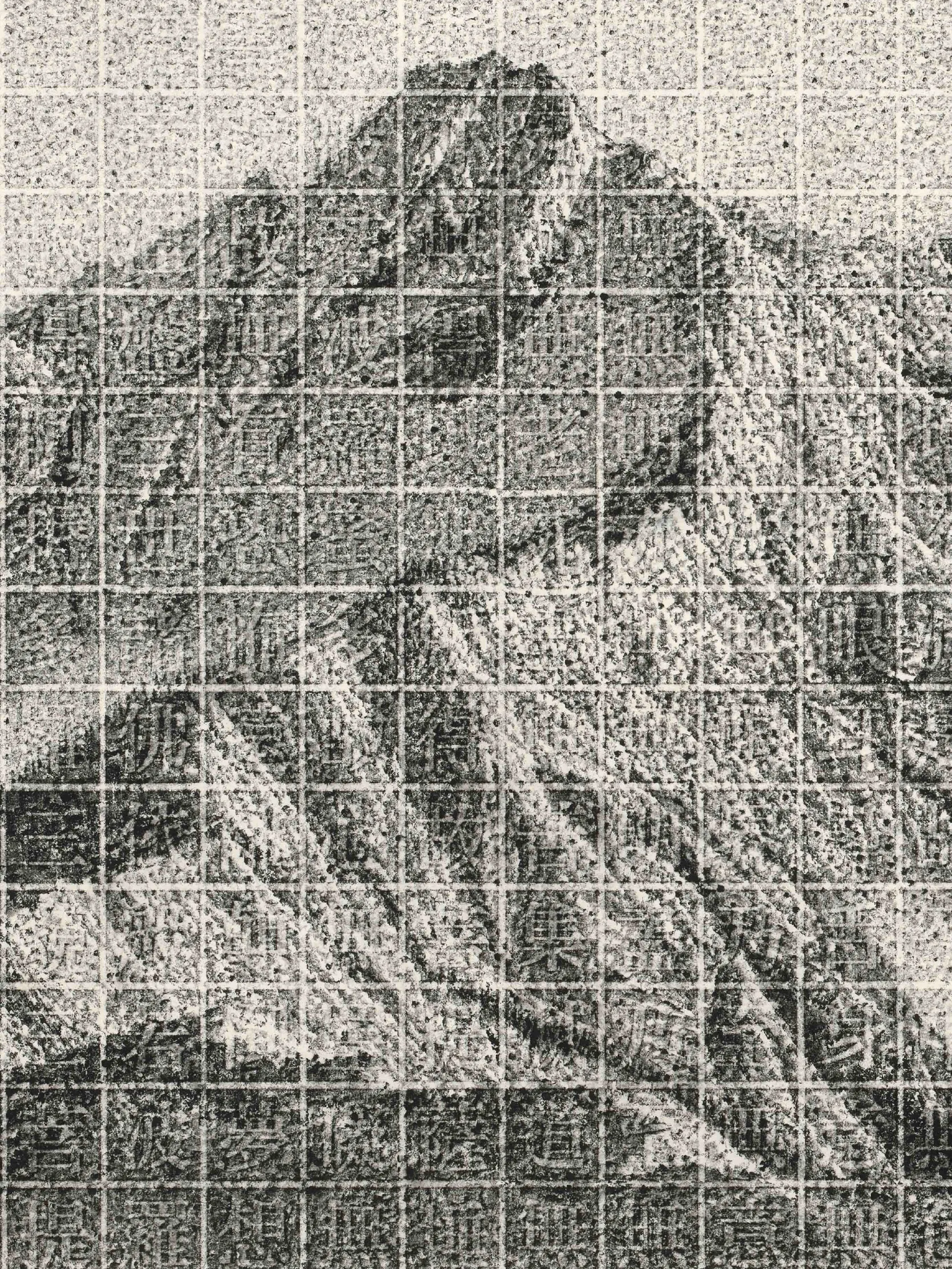
Lee Chun-Yi was influenced by Liu Kuo-Sung’s call to “overthrow the center-tip brush.” Early in his practice, he began using cork to make stamps approximately two centimeters square. By leveraging the granular texture of the cork and varying the pressure and angle of each impression, he produced subtle modulations in surface texture and ink tonality. His paintings often take the form of rigorously structured grids. From a distance, they appear to depict clearly defined forms in a photorealistic manner; up close, however, each square reveals the imprint of a character resembling a stele inscription. Though he has abandoned the use of the brush, the textures produced by these cork stamps have nevertheless been interpreted by some critics as a form of cun (texturing) method. Yet in terms of content, the relationship between the “text” and the “image” in his works is often discontinuous. The grids on his surfaces also recall the pixel structure of digital raster images. In her recent ink paintings, Yen Yu-Ting employs a uniform, unmodulated line reminiscent of a sans-serif typeface. Using a dry-brush technique, she transcribes newspaper texts onto paper, allowing the characters to overlap and accumulate into a surface with a distinctive texture akin to a stone rubbing. She regards this method of transcribing written information, where data, through its own accumulation, dissolves into abstraction, as a personal form of cun method for expressing memory and psychological states. Her use of written text to create painting gestures toward the ancient belief in the “common origin of calligraphy and painting,” while also resonating with the conditions of our contemporary information society, in which images (painting) are generated, reproduced, and manipulated through processes of coding (character/text).
In East Asia, the idea of “poetry and painting as one” and “the common origin of calligraphy and painting” has long held sway. Yet with the onset of modernization, East Asian cultures once embraced concepts such as “unified spoken and written language” and the separation of “calligraphy and painting.” For Taiwanese artists working with ink on paper, this exhibition provides an opportunity to enter into dialogue with Japan’s avant-garde calligraphers, jointly examining the historical dynamics of “poetry,” “calligraphy,” and “painting,” as well as the challenges of unifying word and image through encoding in the digital age. We hope that, through this exhibition, artists and audiences from Taiwan and Japan can revisit our shared cultural heritage, engaging with the works of Inoue Yuichi, Suda Kokuta, Lee Chun-Yi, and Yen Yu-Ting, and from the differences between us, forge new understandings of our present condition and imagine new futures for East Asian culture and the art of calligraphy.
——
Read more


.jpg)

.jpg)
.webp)
.webp)
.webp)
.jpg)
.webp)
.jpg)
.jpg)
.jpg)
.jpg)


.webp)