Beyond the Bounds: Figuring the Nonhuman
By Shen Yu-Chang
Whatis figure painting? At first glance, it appears to be a genredefined by subject matter, namely works depicting the “human figure.” Yet theemergence and boundaries of this category are far from self-evident. Depictionsof “objects” often pursue external likeness, but portrayals of “people” seeknothing less than the evocation of spirit. Why must humans depict themselves,and how should they do so? Such questions inevitably direct our thinking towardthe very nature of the “human.”
Carlvon Linné, founder of modern taxonomy, in his Systema Naturae,identified no specific feature to define humanity, other than restating theancient maxim: nosce te ipsum— “know thyself.” Yet humanity mustknow itself as human precisely in order to become human. As Giorgio Agambenargues in The Open: Man and Animal, to “become human” one mustrecognize oneself within the nonhuman. But since humanity has neither anessence nor a special mission, the human is in its very constitution alreadynonhuman.
Butwhat does it mean, in concrete terms, to “know oneself as human” and thereby“become human”? For Martin Heidegger (The Nature of Language), this maypoint to language and death; for Hans Jonas (Tool, Image, and Grave), itis image and death. In Ovid’s Metamorphoses, the nymph Liriope asks theseer Tiresias whether her handsome son Narcissus will live to old age. The seerreplies: “Yes, if he never knows himself.” This prophecy seems like anextension of the Delphic oracle. Here, self-consciousness and death shadow oneanother, inseparable. And as the myth of Echo and Narcissus demonstrates,“language” and “image” are not merely media of self-knowledge but the very actsthrough which humanity comes to recognize itself as human and to become human.
Death,language, and image all operate through negation: by imagining thedisappearance of the self, death makes the existence of the self perceptible;by depicting the nonhuman, language and image render the human visible. On hisreturn from Troy, Odysseus was trapped in the cave of the man-eating CyclopsPolyphemus—whose name means “famous.” When asked his name, Odysseus answered“Outis,” meaning “Nobody.” In language, the human confronts the “famous”nonhuman, and by calling himself “Nobody” indirectly reveals this truth:humanity is precisely that being which can affirm its existence by negating itthrough language. Georges Bataille, in Lascaux or the Birth of Art,noted that while the animals in the cave paintings were marvelously realistic,the humans refused to depict their own faces. Even when they acknowledged theirhuman form, they immediately concealed it— as if whenever they tried to showthemselves, they had to don the mask of another. Whenever they paintedhumanity, they hid human features behind animal masks. In images, then,humanity encounters the vividly rendered nonhuman, and by portraying itself as“the one wearing an animal mask,” conveys the same truth: humanity is thatbeing which can affirm its existence by negating it through image. Language,image, and death together constitute what Agamben terms the luogo dellanegatività—the place of negativity.
Fromthis perspective, figure painting can no longer be regarded simply as one genreamong others. Rather, it should be understood as an act through which humanitycomes to know itself as human and makes itself human—yet only by first negatingits own existence, and then freely reshaping that existence in order to affirmit. In the earliest images, the human had neither its own face nor its ownfeatures, and thus had to construct its likeness through the nonhuman. It isprecisely by negating the human visage and freely remaking it that humanityappears as a transhuman existence, able to recognize its own face. AcrossEurasia, from the masked figures of Lascaux to the animal-headed gods of Egypt,from the hybrid beings of Hongshan culture to the ox-headed body of Shennong inChinese legend, the earliest human images were all nonhuman figures oftranshuman existence. Even after the rise of Humanism, the creation of suchnonhuman imagery never ceased.
The XuanheCatalogue of Paintings, compiled under Emperor Huizong, divided theimperial collection into ten categories, with “Daoist and Buddhist subjects”and “figures” placed at the forefront. The commentary on Daoist and Buddhistsubjects makes clear that these were not mere idols, but representations ofbearing and spirit—images through which viewers could look up, contemplate,and, by engaging with form, attain an understanding of the Dao. Here, art andDao were seen to flow into one another: when art reaches the level of themarvelous, one no longer knows whether art is Dao or Dao is art. The section onfigure painting likewise notes that likeness alone often falls flat; whatmatters is the capture of spirit and character, qualities beyond verbalargument. The eyes of Yin Zhongkan or the delicate hair on Pei Kai’s cheekswere cited as examples of details that reveal spirit and lofty grace, thingsthat cannot be grasped through discourse alone but only through painting. Thus,both Daoist-Buddhist and secular figures aimed not at mere resemblance but atpresenting spirit, vitality, and transcendence. What they depict is neversimply “the human” in the ordinary sense, but humanity as it moves beyonditself into the nonhuman. In this light, it is only through the nonhuman imagesof different eras that we glimpse the human face of that era and discern itsparticular spirit of the age.
Yang Yu-Ningemploys cursive brushwork, overnight ink and Sheng Xuan (Raw Xuan Paper) torender Christian saints such as the Ave Maria and St. Sebastian. Thetransparent yet dense black of the overnight ink, drawn with broadbrushstrokes, forms winding but continuous bands of lines that depict the robesof the Virgin and the saint, creating folds that appear light and flowing, likefine gauze.
Guo Hui workson silk with color, employing precise and deliberate gongbi linework,complemented by subtle washes of ink-based tones, to reinterpret classicBuddhist subjects such as the Reclining Buddha, arhats, and monks. The robes ofthe arhats and monks are rendered with short, arching lines layered likemountain ridges, combined with gradual shading along the contours, creating asoft yet substantial sense of volume and fullness. They differ insubject—Christianity and Buddhism, in technique—expressive brushwork andmeticulous gongbi line, and in medium—monochrome ink and color.Together, these differences create a striking dialogue within the theme of “Deities”.
Hua Ji-Lin alsoworks with subtle color on paper, favoring relaxed and supple lines combinedwith washes that fade outward from the center of each form. This approachallows ink lines and color to coexist without conflict, while balancing volumeand atmosphere in a deliberately ambiguous way. Her compositions incorporatesymbolic objects and patterns that generate abundant detail for the viewer toread, constructing scenes with narrative implications. The figures are often “FairMaidens”, portrayed with a contemplative presence yet caught in theentanglements of love.
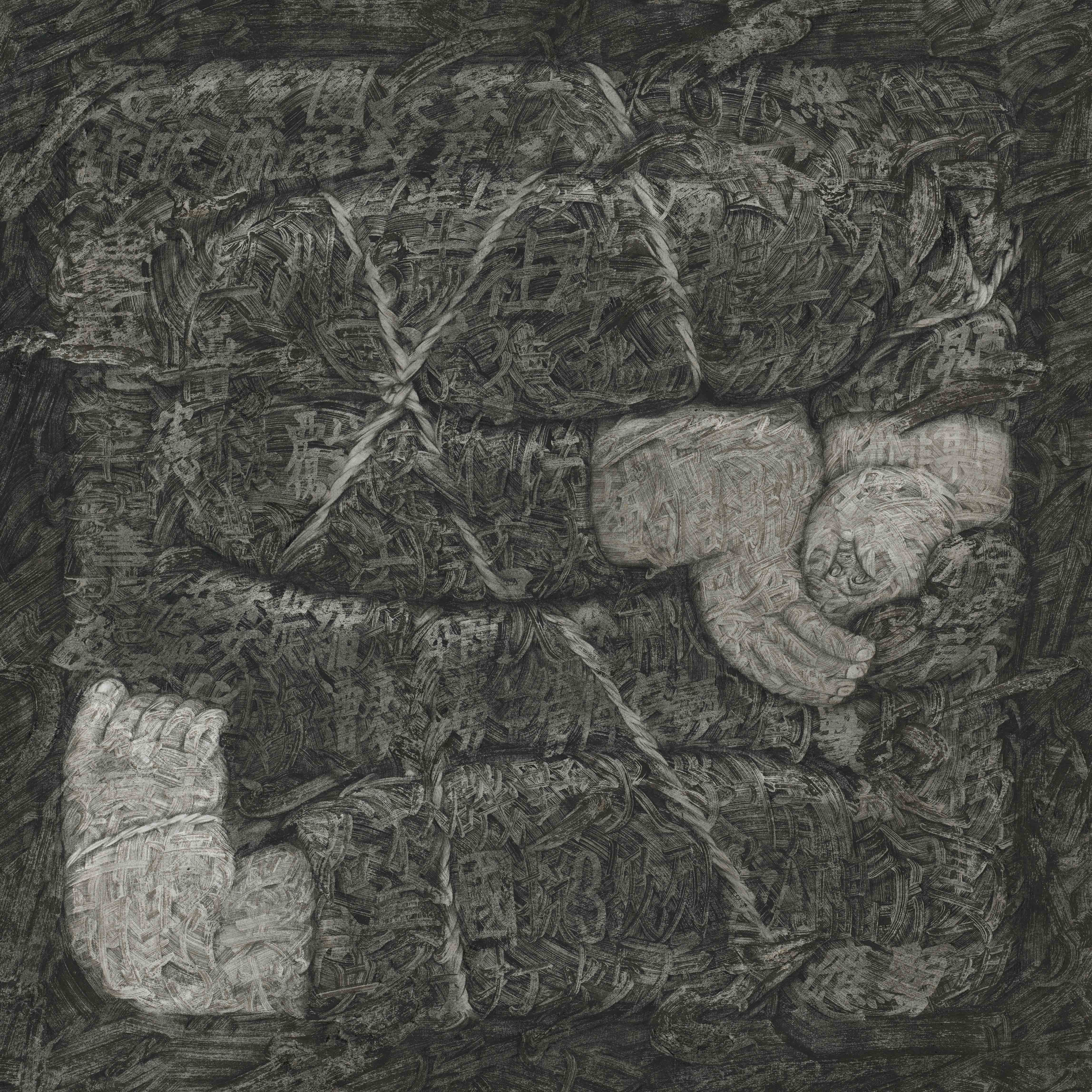
Yen Yu-Ting, inher recent work, begins by copying news texts onto paper with brush and ink,creating a surface densely covered with legible words. Over this ground shepaints nameless figures—bodies bound, compressed, twisted, and distorted beyondrecognition, stripped of individual features. These anonymous beings represent“Wanderers” caught between the physical networks of transportation andthe virtual networks of information, moving through a world shaped by rapidtechnological and economic forces.
Pan Hsin-Hua firstcreates mottled textures on paper, staining them with an antique tone. Uponthis surface he paints distinctive landscapes and local species encounteredduring his travels across Taiwan. At the center of these compositions, a bald,clothed, barefoot—and at times partially unclothed— “Divine Child” oftenstands in quiet presence.
In YuPeng’s landscapes and gardens, painted with a spontaneous brushworkreminiscent of wild cursive script or quick sketches, nude female figures andyoung divine children frequently appear. By contrast, the divine child in PanHsin-Hua’s work is younger, staring wide-eyed and expressionless at theviewer, initially with a sense of playful irreverence. Yu Peng’s divinechild figures are slightly older, sometimes lowering their gaze in a trance orclosing their eyes in melancholy. Although based on his own son, they evoke theDaoist ideal described in the Dao De Jing: “to be the valley of theworld, to remain constant in virtue, and to return to the state of the infant.”At times, Yu Peng’s divine children accompany the fair maiden, or, likewanderers, release themselves into the open landscape.
In the chapter “The Great Master” of the Zhuangzi,those who transcend the ordinary world are described as “wanderers beyond thebounds.” It is from this idea that the exhibition takes its title, Beyondthe Bounds: Figuring the Nonhuman, organized into four sub-themes: Deities,Fair Maidens, Wanderers, and Divine Children. The exhibition brings togethersix contemporary painters and calligraphers—Yu Peng, Hua Ji-Lin, GuoHui, Yang Yu-Ning, Pan Hsin-Hua, and Yen Yu-Ting—acrossYi Yun Art’s Jinhua and Qingtian spaces. The Qingtian space presents Deities(Yang Yu-Ning, Guo Hui) and Fair Maidens (Hua Ji-Lin, Yu Peng), whilethe Jinhua space features Wanderers (Yen Yu-Ting, Yu Peng) and DivineChildren (Pan Hsin-Hua, Yu Peng). Visitors are invited to encounter the“nonhuman images” portrayed in these works and, together with the artists,reflect on how the face of humanity is shaped today.




%EF%BC%8C%E6%B0%B4%E5%A2%A8%E8%A8%AD%E8%89%B2%E7%B4%99%E6%9C%AC%20Ink%20and%20color%20on%20paper%EF%BC%8C65%20x%2043%20cm%EF%BC%8C1992_%E7%B6%B2%E9%A0%81%E7%94%A8.webp)