


Everyday Relativity: Tan Rui-Wen’s "Dust and Halo"
Everyday Relativity: Tan Rui-Wen’s Dust and Halo
by YIYUN ART
Tan Jui-Wen’s solo exhibition Dust and Halo is on view at YIYUN ART Jinghua from August 29 to October 10, 2026. The “dust” and “halo” of the exhibition title, together with the first person “observer” embedded within the works, establish different frames of reference and degrees of psychological distance. Together, they create scenes in which the everyday becomes extraordinary and the extraordinary becomes part of everyday life, reflecting the ways people and their surroundings continually shape one another.
Born in Melaka, Malaysia, Tan has now lived in Taiwan for eighteen years. The two places differ greatly in climate, landscape, and built environment. The initial visual shock and sense of alienation he experienced in Taiwan gradually settled with each passing season, like dust slowly accumulating on the surface of a cabinet, until they became part of the familiar landscape. Yet whenever another period of movement began, whether returning home, relocating, taking up an artist residency, or traveling, places and things held in memory would appear before him again and reveal how much they had changed. It was as though he had to refocus, crossing a blank interval marked by his own absence before reacquainting himself with what had once been familiar. As the familiarity of memory became mixed with displacement and unfamiliarity, the boundary between the ordinary and the fantastical grew increasingly uncertain.
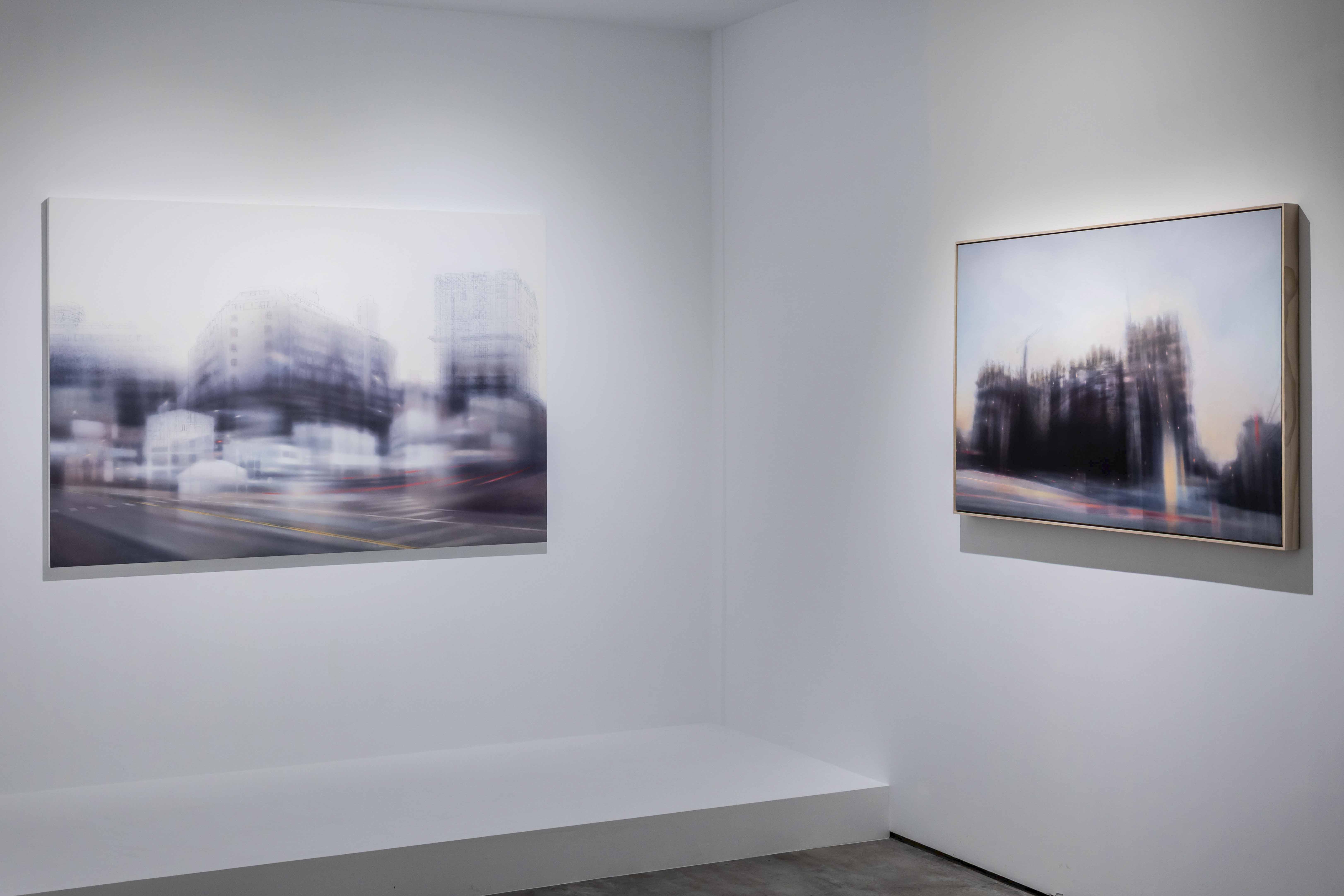
Beginning with this experience of perception, the landscapes in Tan’s work are not representations of a single place or moment, but a layering of ways of seeing. Like a double exposure or a long exposure photograph, they are not necessarily anchored to a fixed viewpoint. Instead, they reveal the environment as fluid rather than fixed, while also showing how often we recognize that fluidity only in hindsight. The world around us is constantly changing and renewing itself, through cycles of growth, decay, and movement in nature, as well as demolition, additions, relocation, and replacement within towns and cities. In this sense, buildings are more than objects to be depicted. They become markers through which the passage of time can be read, much like the changing seasons in nature.
To give these ideas a material form closer to how he experiences them, Tan works with pigments bound with glue, combining them with metal foils, neon acrylic paint, phosphorescent pigments, and other materials. Rather than simply applying paint to paper, he repeatedly builds thin layers with finely powdered materials such as suihi and earth pigments, heavily diluted with water. He then develops the image by rubbing and washing areas back, and by transferring architectural line drawings onto the surface. Pigment particles move from suspension to sedimentation, from adhering to the surface to being washed away. On both material and symbolic levels, these processes echo settling dust and rainfall, suggesting the accumulation and passing of time. The architectural forms, defined by pronounced outer contours, resemble urban planning drawings. From the imagined to the built, from conception to construction, new lines appear over faint traces of what came before, repeatedly rewriting the cityscape. By contrast, metal foils, neon acrylic paint, and phosphorescent pigments stand apart from the delicate powdery surfaces. Their distinctive color and luminosity evoke the countless forms of artificial light and atmospheric phenomena that are at once familiar and strange.
In Black Mountain III, Tan draws on his repeated journeys through the area around Taipei’s North Gate, where he observed and recorded the massive steel frame of a new building rising higher day by day. Set against the historic city gate, the structure reveals how different forms of monumentality belong to different eras. What allows this scale to continue rising is the ceaseless flow of human activity around it. The Course II, meanwhile, draws on views along the waterways of Taichung’s old city. Through shifts in viewpoint while walking and cycling, Tan recombines old and new landmarks encountered at different speeds, positions, and moments, producing an urban landscape poised between reality and illusion.
25.0539°N, 121.5144°E and Circle were inspired by Taipei’s Chien-Cheng Circle, a site that has undergone repeated transformations over more than a century. It began as a park during Japanese rule and later developed into one of Taipei’s best known night markets for local street food. During World War II, an air raid water reservoir was built on the site. After the war, the area became crowded and lively once again. Fires in 1993 and 1999 accelerated the market’s decline and shifted commercial activity elsewhere. A glass walled food center was later built on the site but struggled to attract business. In 2016, the glass structure was demolished, and the site was eventually returned to a green public plaza.
Tan layers architectural structures from different periods into a single image, creating something like an exposure made over many years. At the same time, the image recalls the ringlike forms produced by recent observations of black holes. Under immense gravity, matter is drawn inward, and once it passes the event horizon, it cannot return. Beyond this boundary, not even light can escape. As a metaphor, traces and memories of past lives likewise collapse beneath successive layers of time and rewriting, eventually crossing a threshold beyond which they can no longer be traced or recognized, and disappearing from view.
Other works, including Wind Field, Beneath the Sun's Glow, Twilight, Rosy Cloud, and Glimmers of Light, draw on fleeting natural phenomena encountered by chance in everyday life. These apparently rare spectacles, however, occur more often than we might imagine. Clouds form around condensation nuclei, while glowing skies, iridescence, and halos arise as light interacts with molecules, atmospheric particles, water droplets, or ice crystals under particular conditions. The minute matter carried by air currents thus forms a counterpart to the dust that settles on a desk in everyday life.
Across these shifts between the everyday and the extraordinary, the strange forms produced through the rise and decline of cities can be understood as moments when the everyday becomes extraordinary. Fleeting yet recurring natural phenomena, in turn, reveal how the extraordinary becomes part of everyday life. Human beings within these processes are like motes of cosmic dust, briefly gathering and giving off light within a vast world before dispersing once again, only for the cycle to begin anew.
Throughout Dust and Halo, Tan embeds layers of careful thought and feeling that ultimately converge in the two central images of the exhibition. Dust settles of its own accord until the next gust of wind lifts it again. A halo forms high in the sky, and anyone willing to look up may have the chance to see it. Neither exists in order to be seen. Yet at the moment it is seen, each can make us newly aware of where we are and of the time in which we find ourselves.
///
Related Exhibition: