「夜拾 Nocturnals」創作自述
文|顏妤庭
個展「夜拾」像是一趟在林間漫走的夜遊。我以旅人、遺跡和枯樹為題,在作品中建構出一幕幕似曾相識又難以言明的偶遇。
延續近年來對新聞訊息、記憶與繪畫的思考,我借鏡並轉譯傳統水墨的繪畫語言,藉以捕捉在資訊爆炸、精神與記憶碎片化的當代中所經驗的觀察與感受。對我而言,「夜拾」並無意建立一個宏大且完整的敘事,而是在繪畫與生活的路途中,進行觀察、撿拾、拆解、轉化、重組的一次次動態嘗試。
自2020年起,我的創作媒材由膠彩逐步轉為水墨,並開始探索將「日常新聞」融入「皴法」的可能性。我透過反覆的抄寫將新聞訊息帶入畫面,使傳統繪畫中用以描繪山石肌理的「皴法」,轉化為一種連結文字、訊息與記憶的心理肌理。經由這樣的轉譯,我以不同的途徑延續了水墨繪畫中「書畫合一」的傳統——在此,書寫不再是為了記錄或傳遞意念;相反地,透過層層抄寫,海量的當代訊息隨著時間碎散、交織與堆疊,最終從具體的文字內容,轉變為一種近似金石拓片般的質地,成為某種屬於當代記憶的沈積物。
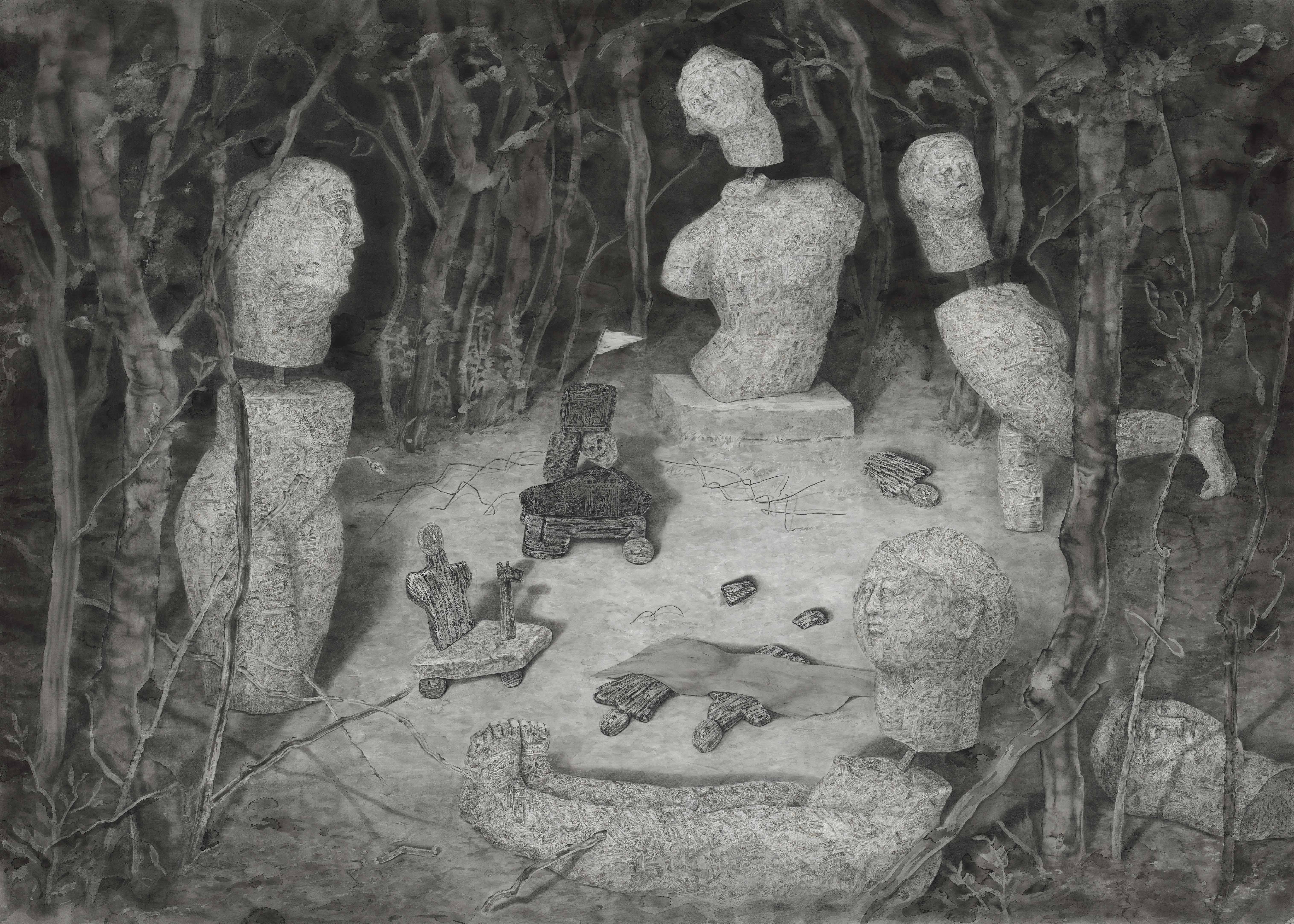
近期的創作受到巫鴻對中西繪畫中「廢墟圖像」之研究的啟發,我以水墨繪畫中「旅客、石碑、枯樹」三者並置時所共構的「懷古」與「古今對映」意涵為背景,去建構一個跨越時空與文化的遺跡。展場中的大尺幅繪畫作品,呈現了在山林間散落的殘碑與雕塑,它們既像歷史留下的紀念碑,也像是被翻模工廠隨意丟棄的報廢品。在這個虛擬的遺跡中,石碑指涉了秩序、共識與歷史的制定;枯樹則隱喻了記憶隨時間流變、衰敗及復生的經驗;而旅人(亦即展場中的觀眾)則作為一個過路的見證者,去感知時間的經過,與記憶和歷史的生滅。
同時,我嘗試以戲謔而弔詭的拼組方式,在畫面中建構出一座座姿態各異的無名殘塊。它們似鳥、似獸、似佛、似鬼,亦似某個平凡不過的生活切片。但其目的並非意圖描繪具體的事件或物體。我更感興趣的,是在構思過程中嘗試各種似是而非的嫁接,並在其中置入觀看的線索與想像的縫隙。這些錯位的拼組,使觀者在辨識與懷疑之間停留,阻滯了快速完成的理解,進而邀請觀者一同參與選擇與遺忘的過程,生成不同的解讀和詮釋。
對我而言,「夜拾」是一處仍在變動中的記憶遺址,畫面中那些姿態各異的遺跡僅是暫時性的拼組,繪畫的目的也無關答案或解釋,而是以我的視角提供一個切入點,去揭示時間、事件、記憶與歷史之間的動態關係。
———
———
Artist Statement for Nocturnals
by Yen Yu-Ting
My solo exhibition Nocturnals is like “a night walk through the forest.” Taking the traveler, ruins, and withered trees as recurring motifs, I construct a series of encounters that feel strangely familiar, yet remain difficult to name.
Continuing my recent reflections on news, memory, and painting, I borrow from and translate the language of traditional ink painting in order to capture the observations and sensations I experience in the present: an age of information overload, and of fragmented states of mind and memory. For me, Nocturnals is not meant to build a grand or complete narrative. Rather, it is a series of active attempts—made along the paths of painting and everyday life—to observe, gather, take apart, transform, and reassemble.
Since 2020, my primary medium has gradually shifted from mineral pigment painting to ink. Around the same time, I began exploring the possibility of incorporating “daily news” into cunfa, or texture strokes. Through the repeated act of transcription, I bring news text into the image, transforming cunfa—traditionally used to describe the texture of rocks and mountains—into a psychological texture that connects writing, information, and memory. Through this process of translation, I continue the ink painting tradition of the unity of calligraphy and painting, but through a different path. Here, writing is no longer used to record or convey ideas. Instead, through layer upon layer of transcription, vast amounts of contemporary information scatter, intertwine, and accumulate over time. In the end, the specific content of the written words is transformed into a texture resembling a rubbing of bronze and stone inscriptions, becoming a kind of sediment of contemporary memory.
My recent work has been inspired by Wu Hung’s research on images of ruins in Chinese and Western painting. Taking as a point of departure the sense of nostalgia and the dialogue between past and present created by the juxtaposition of the traveler, the stele, and the withered tree in ink painting, I construct a site of ruins that crosses time, space, and culture. The large-scale paintings in the exhibition depict ruined steles and sculptures scattered through the mountains and forest. They resemble monuments left behind by history, yet also look like defective cast-offs casually discarded by a molding factory. Within this imagined site of ruins, the stele points to the formation of order, consensus, and history; the withered tree suggests the ways memory changes, declines, and returns over time; and the traveler—that is, the viewer in the exhibition space—becomes a passing witness, sensing the passage of time and the rise and fall of memory and history.
At the same time, I try to construct nameless remnants of many different forms through a playful and paradoxical method of assemblage. They may look like birds, beasts, Buddhas, ghosts, or even an ordinary fragment of daily life. Yet my aim is not to depict any specific event or object. What interests me more is the process of testing out various ambiguous graftings, and of placing within them clues for looking and gaps for imagination. These dislocated assemblages ask viewers to remain between recognition and doubt. They slow down the quick completion of understanding, and invite viewers to take part in the process of selection and forgetting, generating different readings and interpretations.
For me, Nocturnals is a memory site still in motion. The ruins of different forms that appear in the paintings are only temporary assemblages. The purpose of painting is not to offer answers or explanations, but to provide, from my point of view, an entry point into the shifting relationship between time, events, memory, and history.



%E9%A1%8F%E5%A6%A4%E5%BA%AD%E3%80%88%E5%AD%90%E6%99%82%20%E5%99%B4%E6%B3%89%E3%80%89%EF%BC%8C%E6%97%A5%E6%9C%AC%E7%99%BD%E9%BA%BB%E7%B4%99%E3%80%81%E5%A2%A8%E3%80%81%E8%89%B2%E9%89%9B%E7%AD%86%EF%BC%8C186.6%20x%20735%20cm%EF%BC%8C2026_ca_me%E5%B0%8F.jpg)