Artist Statement for Nocturnals
by Yen Yu-Ting
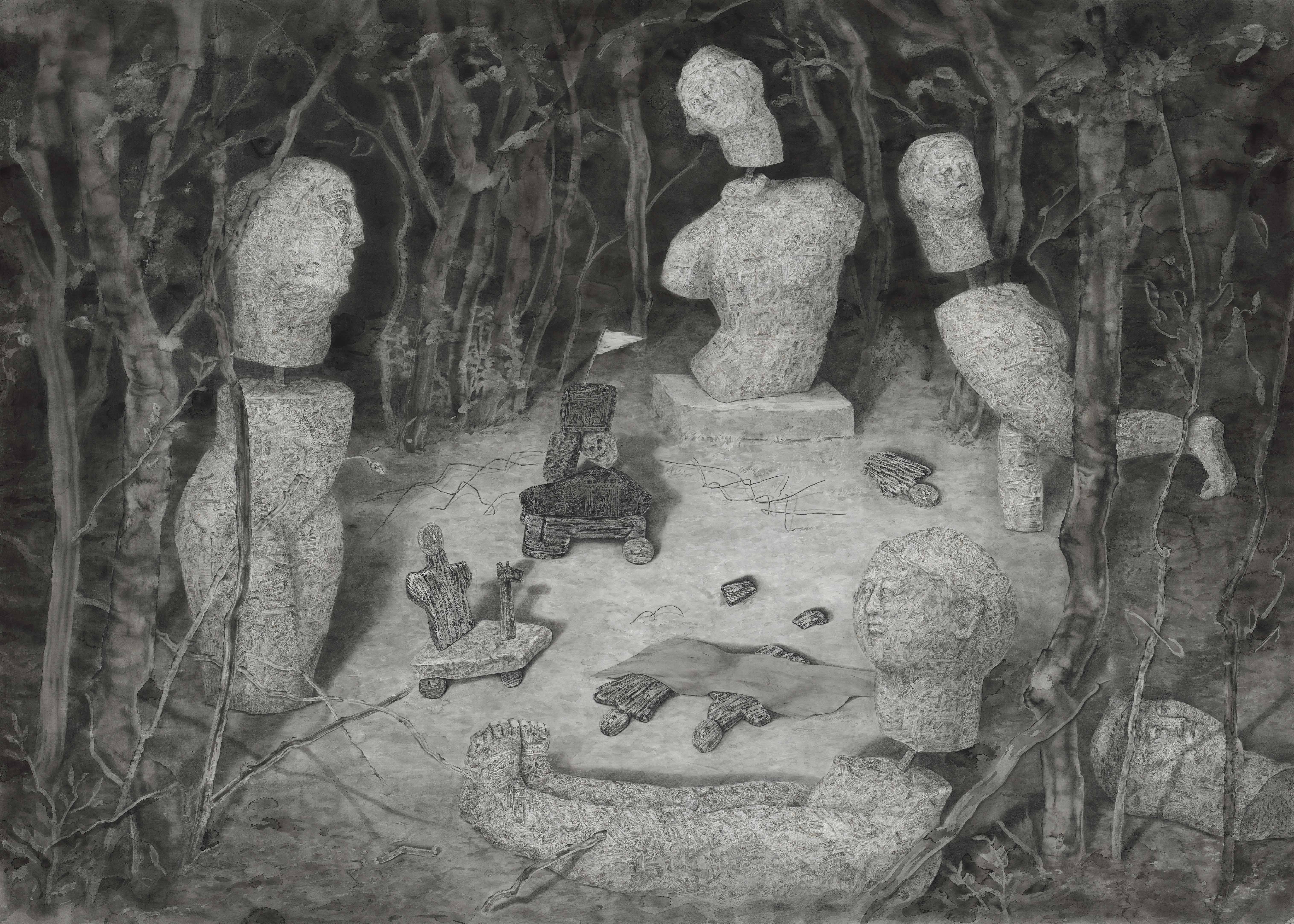
My solo exhibition Nocturnals is like “a night walk through the forest.” Taking the traveler, ruins, and withered trees as recurring motifs, I construct a series of encounters that feel strangely familiar, yet remain difficult to name.
Continuing my recent reflections on news, memory, and painting, I borrow from and translate the language of traditional ink painting in order to capture the observations and sensations I experience in the present: an age of information overload, and of fragmented states of mind and memory. For me, Nocturnals is not meant to build a grand or complete narrative. Rather, it is a series of active attempts—made along the paths of painting and everyday life—to observe, gather, take apart, transform, and reassemble.
Since 2020, my primary medium has gradually shifted from mineral pigment painting to ink. Around the same time, I began exploring the possibility of incorporating “daily news” into cunfa, or texture strokes. Through the repeated act of transcription, I bring news text into the image, transforming cunfa—traditionally used to describe the texture of rocks and mountains—into a psychological texture that connects writing, information, and memory. Through this process of translation, I continue the ink painting tradition of the unity of calligraphy and painting, but through a different path. Here, writing is no longer used to record or convey ideas. Instead, through layer upon layer of transcription, vast amounts of contemporary information scatter, intertwine, and accumulate over time. In the end, the specific content of the written words is transformed into a texture resembling a rubbing of bronze and stone inscriptions, becoming a kind of sediment of contemporary memory.
My recent work has been inspired by Wu Hung’s research on images of ruins in Chinese and Western painting. Taking as a point of departure the sense of nostalgia and the dialogue between past and present created by the juxtaposition of the traveler, the stele, and the withered tree in ink painting, I construct a site of ruins that crosses time, space, and culture. The large-scale paintings in the exhibition depict ruined steles and sculptures scattered through the mountains and forest. They resemble monuments left behind by history, yet also look like defective cast-offs casually discarded by a molding factory. Within this imagined site of ruins, the stele points to the formation of order, consensus, and history; the withered tree suggests the ways memory changes, declines, and returns over time; and the traveler—that is, the viewer in the exhibition space—becomes a passing witness, sensing the passage of time and the rise and fall of memory and history.
At the same time, I try to construct nameless remnants of many different forms through a playful and paradoxical method of assemblage. They may look like birds, beasts, Buddhas, ghosts, or even an ordinary fragment of daily life. Yet my aim is not to depict any specific event or object. What interests me more is the process of testing out various ambiguous graftings, and of placing within them clues for looking and gaps for imagination. These dislocated assemblages ask viewers to remain between recognition and doubt. They slow down the quick completion of understanding, and invite viewers to take part in the process of selection and forgetting, generating different readings and interpretations.
For me, Nocturnals is a memory site still in motion. The ruins of different forms that appear in the paintings are only temporary assemblages. The purpose of painting is not to offer answers or explanations, but to provide, from my point of view, an entry point into the shifting relationship between time, events, memory, and history.
———



%E9%A1%8F%E5%A6%A4%E5%BA%AD%E3%80%88%E5%AD%90%E6%99%82%20%E5%99%B4%E6%B3%89%E3%80%89%EF%BC%8C%E6%97%A5%E6%9C%AC%E7%99%BD%E9%BA%BB%E7%B4%99%E3%80%81%E5%A2%A8%E3%80%81%E8%89%B2%E9%89%9B%E7%AD%86%EF%BC%8C186.6%20x%20735%20cm%EF%BC%8C2026_ca_me%E5%B0%8F.jpg)