


Nocturnal Wandering Toward a New World — Yen Yu-Ting’s 2026 Solo Exhibition Nocturnals
by YIYUN ART
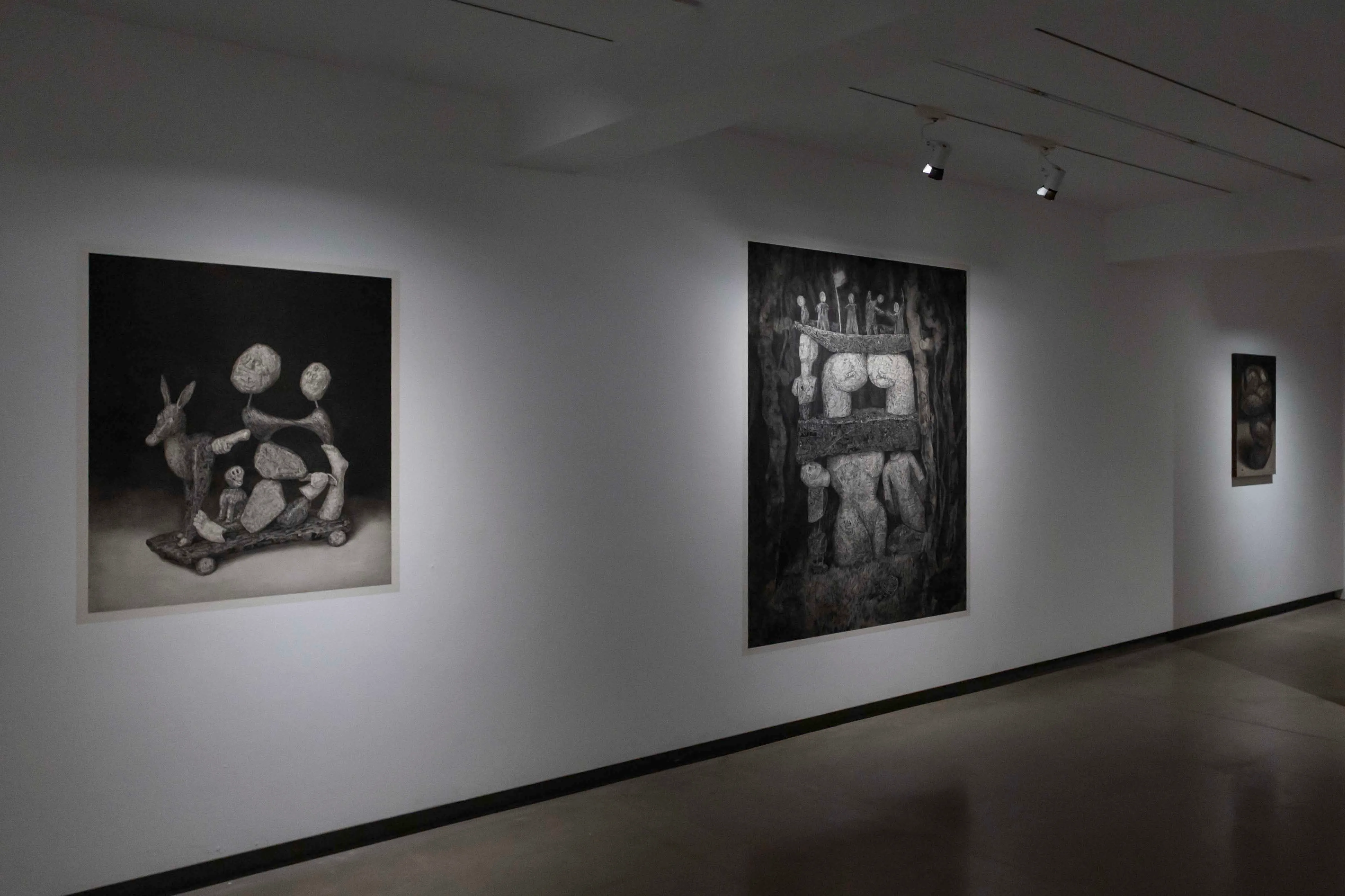
Organized by YIYUN ART, Nocturnals: Yen Yu-Ting Solo Exhibition will be on view from June 13 to July 4, 2026, at Woolloomooloo Xhibit in Taipei. Marking Yen Yu-Ting’s first major solo presentation in three years, the exhibition takes its title, Nocturnals, from the artist’s own description of the works as “a night walk through the forest.” Through her distinctive approach to ink, colored pencil, and other media, Yen renders a series of uncanny scenes encountered while wandering through a forest at night.
▍ Entering the forest at night, one never knows what one might encounter
Under the cover of night, a traveler steps into a forest. Everything here is enveloped in darkness; the field of vision narrows sharply. No matter how one looks around, the forest answers only with depth and silence, remaining almost impossible to grasp. Yet the traveler does not turn back. As this journey into the unknown deepens, the points of reference for orientation gradually fade. Then, all at once, the traveler comes to a halt: something seems to be blocking the path ahead.
Unknown ruined steles and statues stand on their own in a wild clearing, surrounded by withered trees. No one knows when or where they came from. These relics are objects severed from their original context and meaning. As the artist writes, “They resemble monuments left behind by history, yet also look like defective cast-offs casually discarded by a molding factory.” Around them, trees grow freely, moving through cycles of flourishing and decay. Wild nature and scattered fragments are, in essence, unrelated to one another—until the traveler enters this site and becomes a witness to the scene. It is through this encounter that the traveler begins to sense the transformation and disappearance of time, memory, and history, and to give them interpretation.
▍ A new composite form is born, quietly reveling in itself
The scenes in the forest are absurdly lively and strangely quiet. Fragments from different times, cultures, and materials are joined and recomposed in ways beyond expectation. Between the gaps of withered trees, incomplete objects form another kind of whole. They seem to hold their own parties, picnics, and games of make-believe, or to assemble a marching band without sound or song. At other times, they gather in arrangements that are at once random and subtle, forming images that feel familiar yet are not quite what they seem: a house that is not a house, a sundae that is not a sundae, a caged bird that is not a caged bird.
The uncanniness produced by these dislocations interrupts the habitual assumptions through which contemporary viewers tend to recognize and categorize images. It slows down the quick formation of fixed meanings and opens a path for doubt and reflection. At the same time, it also mirrors the way information is received in the present age. Like a cross-section, it reveals the uneven and entangled details of contemporary perception beneath the appearance of a unified whole.
▍ Only a contemporary form of cunfa can project the psychological state of our time
In response to the disorder and constant change of the present, as well as the peculiar psychological conditions of contemporary life, Yen Yu-Ting has developed a highly personal form of painterly cunfa. In traditional ink painting, cunfa refers to the various texture strokes used to describe the surface and structure of a subject. Over time, it also came to function as a symbolic language through which the inner life of the painter could be expressed. Across the long history of ink painting, different periods gave rise to new forms of cunfa that corresponded to the spirit of their own time. This became a key starting point for Yen’s exploration of a personal cunfa.
Yen’s cunfa emerges from the repeated transcription of vast amounts of news text onto the image. Through this process, she creates a texture that is both visual and psychological, projecting the mental state of contemporary people. At the level of meaning, her practice continues the traditional idea of the unity of calligraphy and painting, while charting a distinctly different path forward. Looking back across Yen’s artistic development, one can trace the beginning of this painterly inquiry to her 2018 residency at the Gwangju Museum of Art in Korea. It was further developed in her 2021 solo exhibition Fragments and Remnants and her 2023 solo exhibition The Fragment. In this latest presentation, the language has reached a greater maturity, becoming more fluid, flexible, and richly layered in its capacity for close reading.
For those who dare to set out into the deep of night, the clues leading toward a new world may be found everywhere.
———
Artist Statement for Nocturnals | by Yen Yu-Ting
///
Related Exhibition: