


通往新世界的夤夜漫遊 —— 顏妤庭 2026年個展「夜拾」
文|異雲書屋
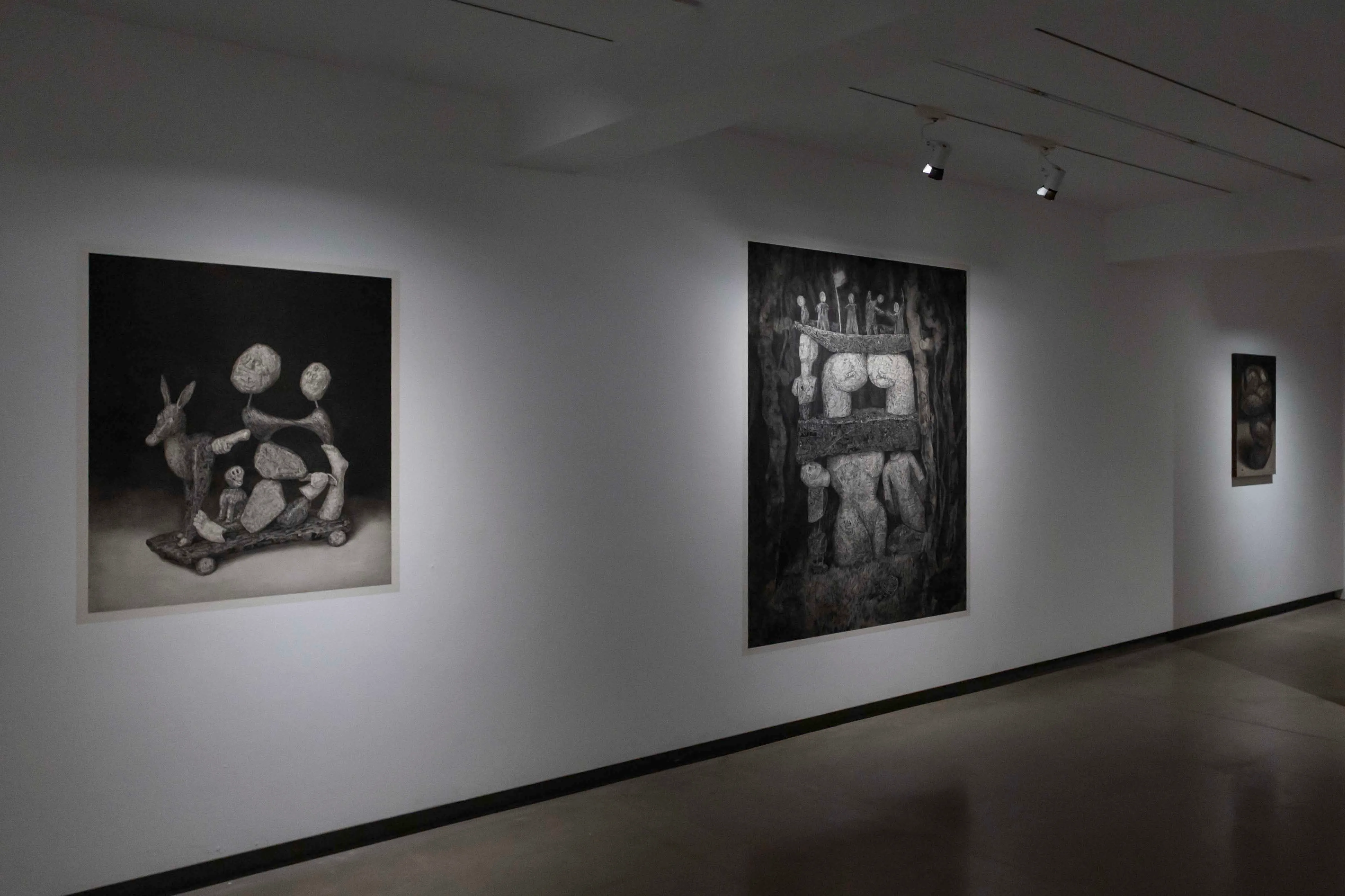
「夜拾 —— 顏妤庭 個展」由異雲書屋主辦,於2026年6月13日至7月4日,在台北Woolloomooloo Xhibit展出。本次展覽為藝術家顏妤庭睽違三年之重要個展發表,展題「夜拾」如其創作自述「像是一趟在林間漫走的夜遊」,顏妤庭以獨到的筆法,運用水墨、色鉛筆等媒材,繪寫一幕幕於黑夜森林間漫遊所見的異景。
▍ 走進夜晚的森林,你不知道自己將會偶遇什麼
在夜色中,旅人步入一片森林,此處的一切已為幽暗所包圍,令視野大幅收斂,無論如何四顧張望,森林皆回以深邃與靜默,幾乎不可觀測。而旅人並未因此卻步,隨著這趟對未知的探索越加深入,辨認方位的依憑也逐漸稀薄,忽然間,移動的腳步暫停下來,前路似乎被什麼東西阻擋了——不知名的殘碑與雕像,在枯樹環繞著的野地中兀自佇立。沒有人知道它們來自何時何處,這些遺跡是失去脈絡與意義的造物,藝術家自述提到:「它們既像歷史留下的紀念碑,也像是被翻模工廠隨意丟棄的報廢品。」其周圍林木恣意生長,在榮枯間輪迴往返,野性的自然與四散一地的碎塊,本質上互不相關,直至旅人涉足了這個場域,成為即景的見證者,從中感知到時間、記憶、歷史的流變與消逝,並賦予解讀及詮釋。
▍ 一種新的複合體誕生了,安靜地狂歡著
林中的場景荒誕地熱鬧又安靜,那些來自於異時空、異文化、異材質的碎塊局部,以臆想之外的方式被接合、重組,就在枯木的間隙裡,不完整的物件構成另一種新的整體,自顧自地舉辦起派對、野餐、家家酒,組織無聲無歌的行進樂隊;又或者它們既胡亂又微妙地集結一處,聚合成似曾相識又似是而非的物象:不是小屋的小屋、不是聖代的聖代、不是籠鳥的籠鳥。在此等錯位中所產生的異樣感受,一方面梗塞著當代人慣習的認知偏誤,阻卻定見的快速生成,從而開闢出懷疑思考的蹊徑;另一方面又作為當前時代接收資訊模式的參照,如剖面般地揭露當代人在整體概念之下的認知細節,實在是參差錯雜。
▍ 當代的「皴法」方足以投射當代人的心理狀態
因應這般混沌且不斷變動的時代特性,以及當代人奇異的心理狀態,顏妤庭投注思索並發展出獨具個人特色的繪畫「皴法」。傳統意義上的水墨畫「皴法」,是一種用以表現描繪對象的肌理而產生之特殊繪畫筆法的統稱,後又引申為寄託心靈的象徵符號,在過去漫長的歷史中,不同的時期,皆發展出了對應當下時代的新皴法,這成為了顏妤庭探究個人皴法的主要契機。其皴法來自於反覆抄寫海量的新聞訊息於圖像上,形成兼具視像與心理的肌理,投射出當代人的心境狀態;同時在意義層面承接傳統中「書畫合一」的脈絡,卻用一種截然不同的方式開啟了新局。爬梳顏妤庭過往的創作歷程,可以觀察到這樣的繪畫思考濫觴於2018年駐村在韓國光州市立美術館時的嘗試,隨後在2021年「殘章與斷片」、2023年「殘片」兩回個展中持續發展,到本次的個展中趨於成熟,並且更加自在靈活,令品讀的趣味益發醇厚。
想來膽敢於夤夜啟程的漫遊者,那些通往新世界的線索,俯拾即是。
———
Nocturnal Wandering Toward a New World
— Yen Yu-Ting’s 2026 Solo Exhibition Nocturnals
by YIYUN ART
Organized by YIYUN ART, Nocturnals: Yen Yu-Ting Solo Exhibition will be on view from June 13 to July 4, 2026, at Woolloomooloo Xhibit in Taipei. Marking Yen Yu-Ting’s first major solo presentation in three years, the exhibition takes its title, Nocturnals, from the artist’s own description of the works as “a night walk through the forest.” Through her distinctive approach to ink, colored pencil, and other media, Yen renders a series of uncanny scenes encountered while wandering through a forest at night.
▍ Entering the forest at night, one never knows what one might encounter
Under the cover of night, a traveler steps into a forest. Everything here is enveloped in darkness; the field of vision narrows sharply. No matter how one looks around, the forest answers only with depth and silence, remaining almost impossible to grasp. Yet the traveler does not turn back. As this journey into the unknown deepens, the points of reference for orientation gradually fade. Then, all at once, the traveler comes to a halt: something seems to be blocking the path ahead.
Unknown ruined steles and statues stand on their own in a wild clearing, surrounded by withered trees. No one knows when or where they came from. These relics are objects severed from their original context and meaning. As the artist writes, “They resemble monuments left behind by history, yet also look like defective cast-offs casually discarded by a molding factory.” Around them, trees grow freely, moving through cycles of flourishing and decay. Wild nature and scattered fragments are, in essence, unrelated to one another—until the traveler enters this site and becomes a witness to the scene. It is through this encounter that the traveler begins to sense the transformation and disappearance of time, memory, and history, and to give them interpretation.
▍ A new composite form is born, quietly reveling in itself
The scenes in the forest are absurdly lively and strangely quiet. Fragments from different times, cultures, and materials are joined and recomposed in ways beyond expectation. Between the gaps of withered trees, incomplete objects form another kind of whole. They seem to hold their own parties, picnics, and games of make-believe, or to assemble a marching band without sound or song. At other times, they gather in arrangements that are at once random and subtle, forming images that feel familiar yet are not quite what they seem: a house that is not a house, a sundae that is not a sundae, a caged bird that is not a caged bird.
The uncanniness produced by these dislocations interrupts the habitual assumptions through which contemporary viewers tend to recognize and categorize images. It slows down the quick formation of fixed meanings and opens a path for doubt and reflection. At the same time, it also mirrors the way information is received in the present age. Like a cross-section, it reveals the uneven and entangled details of contemporary perception beneath the appearance of a unified whole.
▍ Only a contemporary form of cunfa can project the psychological state of our time
In response to the disorder and constant change of the present, as well as the peculiar psychological conditions of contemporary life, Yen Yu-Ting has developed a highly personal form of painterly cunfa. In traditional ink painting, cunfa refers to the various texture strokes used to describe the surface and structure of a subject. Over time, it also came to function as a symbolic language through which the inner life of the painter could be expressed. Across the long history of ink painting, different periods gave rise to new forms of cunfa that corresponded to the spirit of their own time. This became a key starting point for Yen’s exploration of a personal cunfa.
Yen’s cunfa emerges from the repeated transcription of vast amounts of news text onto the image. Through this process, she creates a texture that is both visual and psychological, projecting the mental state of contemporary people. At the level of meaning, her practice continues the traditional idea of the unity of calligraphy and painting, while charting a distinctly different path forward. Looking back across Yen’s artistic development, one can trace the beginning of this painterly inquiry to her 2018 residency at the Gwangju Museum of Art in Korea. It was further developed in her 2021 solo exhibition Fragments and Remnants and her 2023 solo exhibition The Fragment. In this latest presentation, the language has reached a greater maturity, becoming more fluid, flexible, and richly layered in its capacity for close reading.
For those who dare to set out into the deep of night, the clues leading toward a new world may be found everywhere.
———
「夜拾 Nocturnals」創作自述 | 文:顏妤庭
///
Related Exhibition: