2026 ART TAIPEI

2026 ART TAIPEI

‍

✦ 𝘗𝘢𝘳𝘵𝘪𝘤𝘪𝘱𝘢𝘵𝘪𝘯𝘨 𝘈𝘳𝘵𝘪𝘴𝘵𝘴

——

‍

 PU Xinyu

 YU Cheng Yao

 TAI Jing Nong

 SUDA Kokuta

 INOUE Yuichi

 CHEN Chi Kwan

 Yu Peng

 WU Shi Wei

 Bu Zi

 LIU Xin

 MENG Qiang

 Chang Ling

 Muran

 ZHU Xiaozhu

 YEN Yu Ting

‍

Taipei World Trade Center Exhibition Hall 1 (No.5, Sec. 5, Xinyi Rd., Xinyi Dist., Taipei City, Taiwan)
10/30/2026
11/2/2026
預約導覽服務

策展論述

Learn More
收合

Artists

Pu Xinyu(溥心畬)

PU Xinyu (1896–1963), born into the Aisin Gioro imperial family of the Qing dynasty, was one of the most influential painters, calligraphers, and poets of twentieth-century Chinese art. Known alongside Zhang Daqian as “South Zhang, North Pu,” and together with Huang Junbi and Zhang Daqian as one of the “Three Masters Crossing the Sea,” he later taught at the Department of Fine Arts at National Taiwan Normal University. Deeply rooted in traditional Chinese culture, Pu excelled in poetry, calligraphy, landscapes, bird-and-flower painting, and figure painting, and was often regarded as “the last great literati painter.” Yet beyond preserving tradition, he developed a highly distinctive artistic language that combined classical refinement with a modern sensibility. His elegant small-format paintings, innovative boneless landscape techniques, and even humorous comic-like works revealed both profound scholarship and remarkable creativity. After relocating to Taiwan, Pu created numerous works inspired by local scenery such as Taroko Gorge and Beitou’s Phoenix Pavilion. Rather than simply depicting nature, he transformed personal experience and poetic imagination into expressive visual worlds, embodying the literati ideal of “poetry within painting, and painting within poetry.” For PU Xinyu, painting was not merely a technical discipline, but the culmination of scholarship, character, and spiritual cultivation. Through his mastery of tradition and innovative artistic vision, he opened new possibilities for modern literati painting and remains one of the defining figures of modern Chinese art.
more

Yu Cheng-Yao(余承堯)

Yu Cheng-Yao (February 28, 1898 – April 4, 1993), born Yu Shun with the courtesy name Cheng-Yao, was a native of Yangshang Township, Yongchun County, Fujian. In 1920, he went to Japan, where he studied economics at Waseda University before transferring to the Imperial Japanese Army Academy in Tokyo. After returning to China, he taught tactics at the Whampoa Military Academy, retired with the rank of lieutenant general in 1946, and came to Taiwan in 1949, the year the Nationalist government relocated there. Having spent the first half of his life in the military and in business, he did not take up painting until the age of 56, earning him the title “the General Painter.” Self-taught and taking nature as his only teacher, he built up rock textures and dense mountain structures with fine, tightly woven brushstrokes. Shaped by his travels across China’s mountains and rivers in his early years, his ink paintings carry a grand, lofty spirit and a style entirely his own, securing him an important place in modern Asian ink painting. His major exhibitions include his first overseas solo exhibition, at the Chinese Cultural Center in New York in 1977; his first solo exhibition in Taiwan, held at the age of 88 at Hsiung Shih Gallery in Taipei in 1986; a solo exhibition at Hong Kong City Hall in 1987; Yu Cheng-Yao at Ninety: A Retrospective at the National Museum of History in Taipei in 1988; and A Heart-warming Glance: Calligraphy and Paintings by Yu Cheng-Yao at the National Museum of History in 2015.
more

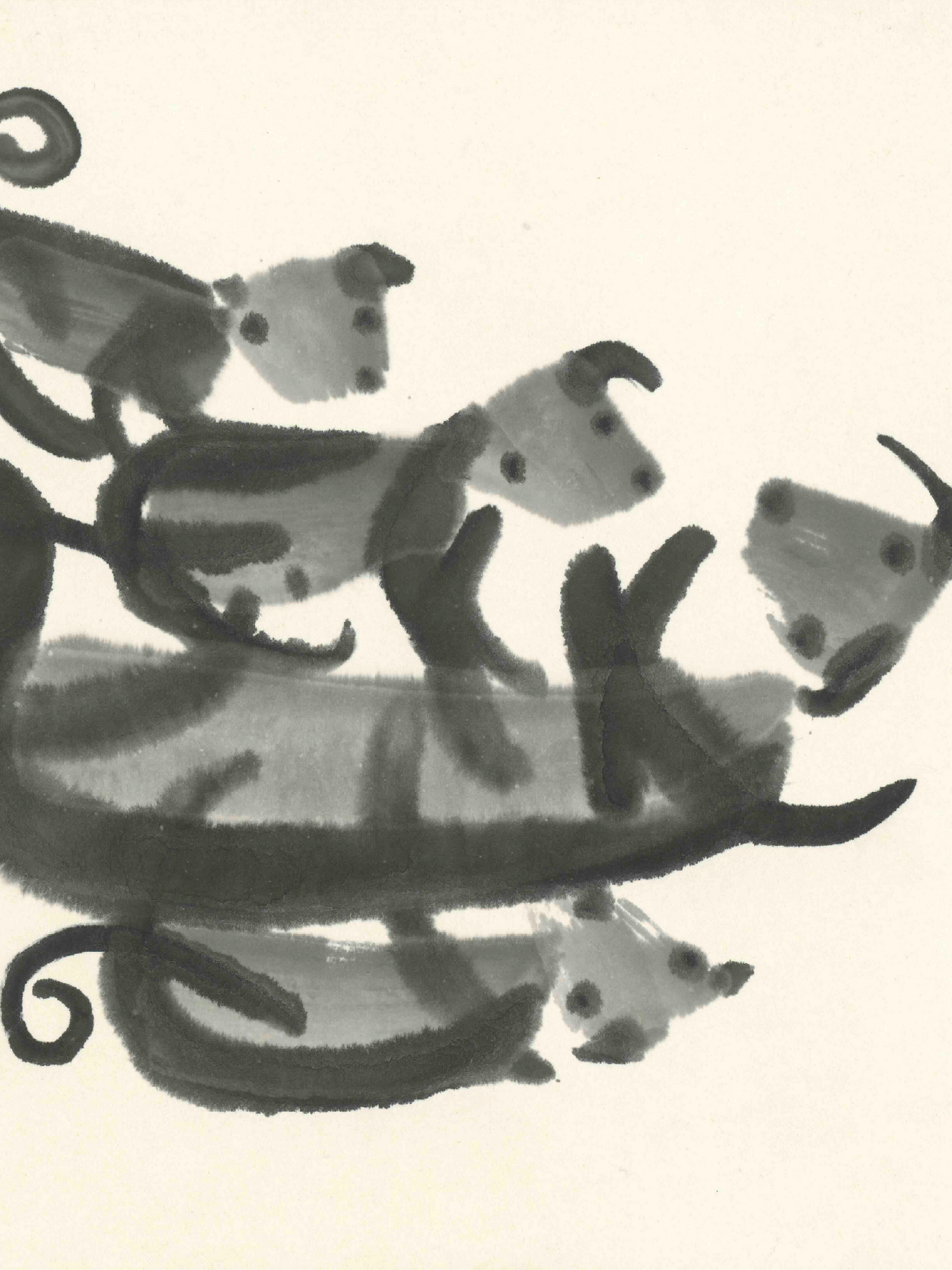
Chen Chi-Kwan(陳其寬)

Chen Chi-Kwan (1921–2007) was born in Beiping (present-day Beijing). From an early age, he received a classical education in Chinese literature and calligraphy, studying seal, clerical, regular, running, and cursive scripts, which laid a profound foundation for his traditional aesthetic sensibilities. During the Sino-Japanese War, his family relocated frequently before eventually settling in Chongqing, where he studied architecture at National Central University. After serving as a translator in the China-Burma-India theater during World War II, Chen later traveled to the United States in 1948 to continue his studies. In 1951, he joined Walter Gropius’s architectural firm and was subsequently invited to teach at the Massachusetts Institute of Technology. In 1954, at the invitation of I. M. Pei, he returned to Taiwan to participate in the planning of Tunghai University. He later founded the Department of Architecture at Tunghai University and independently designed and supervised the construction of the iconic Luce Memorial Chapel, establishing his lasting connection with Taiwan. Beyond architecture, Chen Chi-Kwan was also an accomplished painter. Beginning during his years in the United States, he held solo exhibitions at major university museums and galleries across America. His paintings broke away from the conventions of traditional Chinese painting by integrating architectural concepts, spatial imagination, and natural imagery into a highly personal visual language. Viewing the world through what he described as the “mind’s eye,” Chen developed a style that was both refined and unconventional—rooted in the spirit of traditional Chinese literati painting while infused with the ideas and aesthetics of Western modernism. His works expanded the visual possibilities of landscape and reshaped perceptions of beauty and space. Art historian Wu Neisun famously praised him as “the first in three hundred years,” leading to the saying: “One Zhang Daqian in three hundred years, one Chen Chi-Kwan in five hundred.”
more

Yu Peng(于彭)

Yu Peng was born in 1955 in Waishuangxi, Taipei, Taiwan, and passed away in 2014. He grew up in a relatively stable postwar era. After completing his military service, he worked as a street artist in Taipei’s New Park (now 228 Peace Memorial Park), drawing portraits for visitors. His years as a street artist sharpened his quick and keen powers of observation and made him a highly skilled figure sketcher. Yu Peng’s career can be divided into three periods: early (1980–1997), middle (1998–2004), and late (2004–2014). His early output consisted mostly of drawings and watercolors. His drawing style was deeply inspired by Chen Yigeng, and the influence of Taiwanese and international artists he encountered through “Lion Art” and “Artist” magazines is also evident. In 1997, at the invitation of his friend Zheng Zaidong, he moved to Shanghai, where he lived for three years and traveled widely across mainland China. This experience greatly enriched the depth and range of his ink landscapes and figure paintings, with his “Desire Landscapes / Figures” series standing as the representative work of this period. From 2005 until his death in 2014, he continued to travel frequently between Taiwan and mainland China, taking part in numerous projects and exhibitions. Although Yu Peng is best known for his ink painting, his early drawings and pastels reveal the source of its strength: the successful transformation of Western drawing lines into the remarkable brushwork of his middle and late periods. His works are marked by originality and a strongly personal mode of expression.
more

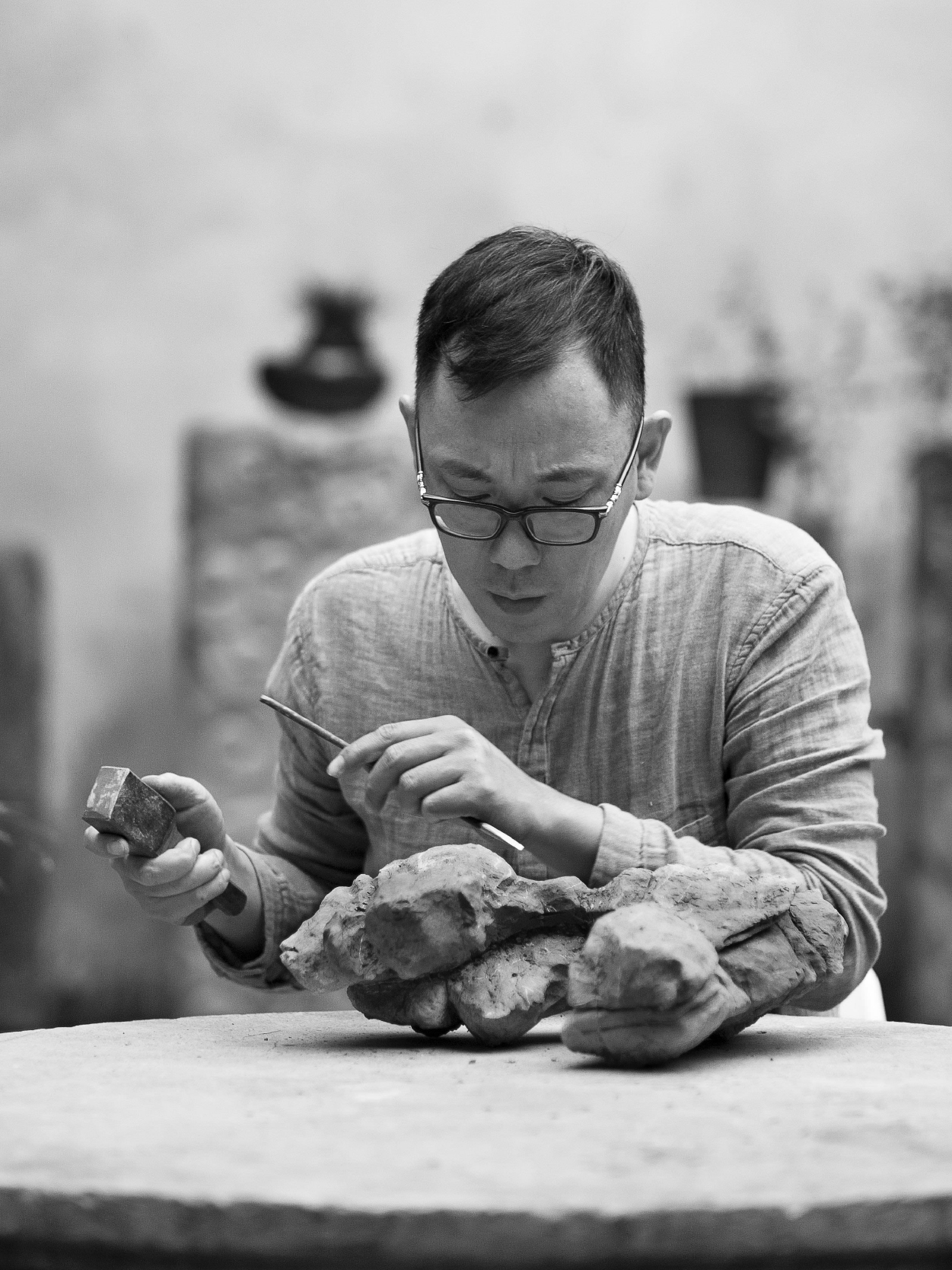
Meng Qiang(孟強)

Born in 1974, Meng Qiang holds a Master’s degree from the School of Art at Soochow University. He was named a “Suzhou Arts and Crafts Master” in the third round of the title’s conferral, and is a board member of the Suzhou Museum Association, an executive director of the Suzhou Arts and Crafts Industry Association, and head of the designated safeguarding unit for the Suzhou Intangible Cultural Heritage item “Scholar’s Rock Processing Techniques.” He is also a member of the Suzhou Copyright Bureau Expert Committee and currently serves as Director of the Suzhou Brick Carving Museum. A passionate connoisseur of antiquities with an extensive personal collection, Meng has devoted himself to the study of Suzhou-style brick carving, garden stone engraving, and the literati tradition of scholar’s rock appreciation. His academic and creative work is rooted in these areas, supported by a substantial body of essays and publications. With over twenty years of experience in scholar’s rock research, Meng has undertaken more than a hundred field investigations and stone selection trips to major stone-producing regions. He specializes in identifying, refining, cleaning, and enhancing stones such as Taihu, Lingbi, and Ying rocks, along with crafting their display stands and mounts. His efforts have resulted in numerous outstanding works, some of which are now housed in museums across China. He has received multiple awards in national arts and crafts exhibitions, and his writings—combining theoretical insight with hands-on experience—have been widely published in professional academic journals.
more

Artworks

陶淵明全集卷第六—桃花源記 The Peach Blossom Spring

more
2026 ART TAIPEI
如該預約時段已滿,我們將會與您聯繫。
此展覽結束日期為:
11/2/2026
謝謝您,預約申請已送出
我們將會儘快與您聯繫
完成
請再檢查一下是否已正確填寫各項目資料,謝謝您。